
You should never start a sentence without knowing the end of it. — Paul Dirac
Given the title and quote above, you can probably guess the argument. That you can is the point. From a title and a vaguely relevant quote, you already have a rough sense of the words, sentences, and paragraphs to come. Those expectations didn't arise from a few adjacent words. They came from connections spanning your entire background and reaching into the future of an article you have just begun to read.
This ability reflects a property of language itself. And it turns out to be a defining property of what makes large language models (LLMs) work.
Some of the connections between LLMs and physics to come are more than analogies. The softmax function that converts a language model's raw output logits into a probability distribution over the next token is the Boltzmann distribution from statistical mechanics. They are the same equation, and the physical intuition carries over too. Just as the Boltzmann distribution assigns probabilities to physical microstates according to their energy, softmax defines a probability distribution over accessible next states, weighted by an energy-like quantity at a given temperature. The temperature parameter that controls how creative or conservative a model's output will be is the same parameter from statistical physics, governing how sharply the distribution favors low-energy (high-probability) states.
These identities give us a framework for understanding LLMs. Training an LLM is, at its core, an intensive search for structure in all of natural language. But the interesting question isn't that it finds structure; it's what kind of structure is found, and how the representation of that structure accounts for the emergent capabilities we see as these models scale up.
The thesis of this article is that language lives at or near a critical point where correlations exist at every scale simultaneously and no single scale dominates. If that's the case, then LLMs are building internal models of this critical geometry during training. This frame of reference leads to an interesting perspective on how and why LLMs work that goes well beyond just predicting the next token.
1. Three Regimes: Randomness, Determinism, and the Critical Point
To understand what a critical point is and why it matters, consider the extremes on either side.
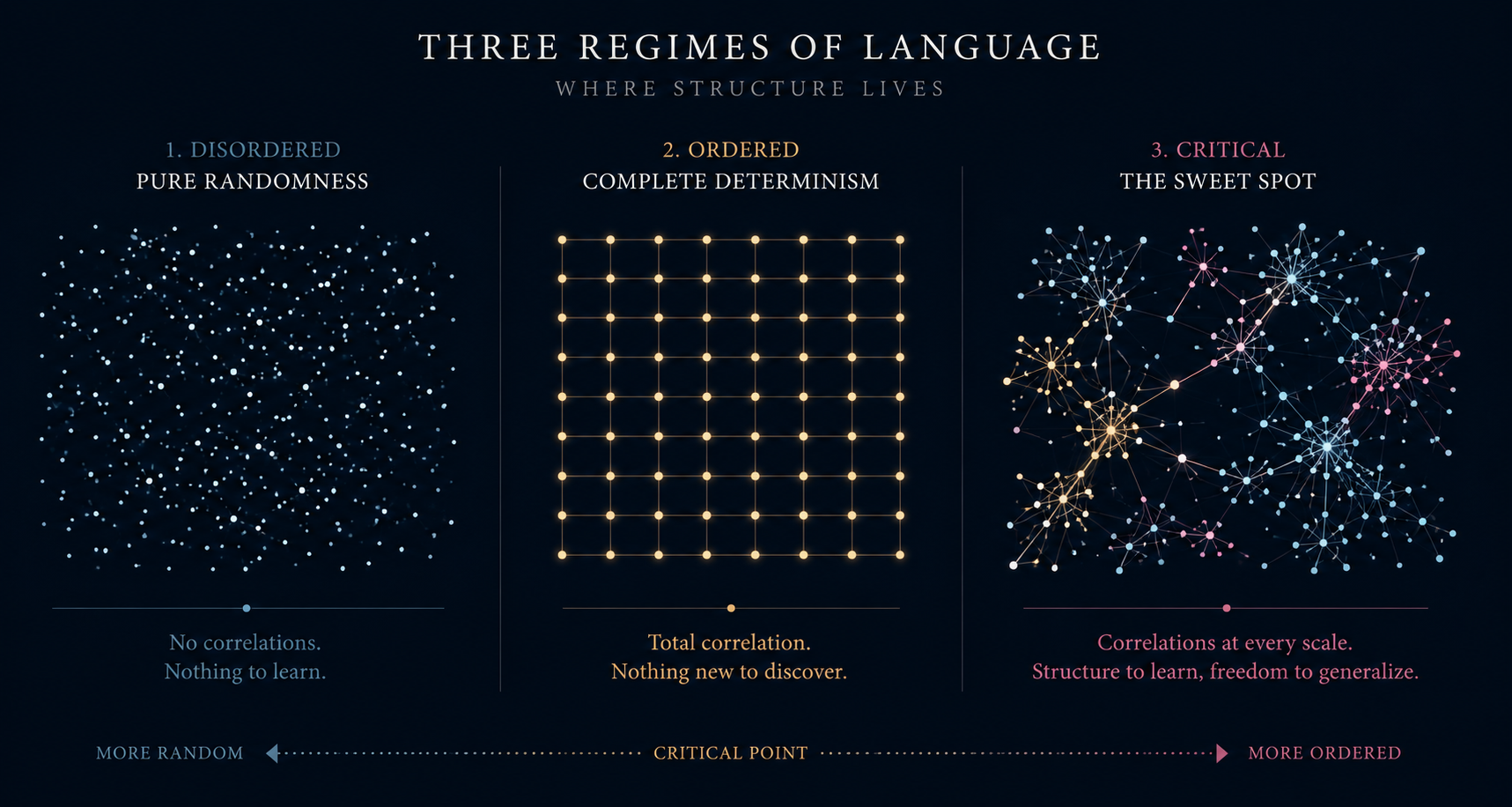
1.1 The disordered extreme: pure randomness
Imagine a language where every word is statistically independent of every other. Knowing the previous thousand words tells you absolutely nothing about the next. There are no phrases, no grammar, no narrative arcs; just a featureless distribution that never changes no matter how much context you accumulate.
A model trained on this data learns nothing. Every correlation it might try to exploit is a mirage. The loss function hits a floor set by the entropy of the token distribution, and no amount of additional parameters or training compute moves it lower. This is the disordered phase: maximum entropy, zero structure, nothing to learn.
1.2 The ordered extreme: complete determinism
Now imagine the opposite. Given the first half of War and Peace, the second half follows word-for-word with 100% probability each and every time. The entire text is a single rigid structure. Correlation is total and the sequence is fully determined. Every token follows inevitably from every other token. Congratulations, you have an expensive lookup table.
A model trained on this data doesn't learn structure; it memorizes a sequence. It can reproduce that sequence perfectly, but it has learned nothing that transfers. Give it a prompt it hasn't seen before and it has no useful response. It learned one frozen trajectory through the space of possible texts.
These are the two dead ends. One extreme gives you nothing to learn; the other gives you exactly one thing. Neither randomness nor determinism produces a model that can generalize, compose, or handle novel input. Now the interesting question: what lies between?
1.3 The critical point
Between perfect order and perfect disorder, there is a narrow region where correlations exist at every scale simultaneously (adjacent words, clauses, paragraphs, narrative arcs) but no single scale dominates. Local structure coexists with global structure. There is pattern to exploit everywhere because complete certainty is absent. This is the critical point.
Critical points are a widely studied phenomenon in physics, and they come with a distinctive set of properties:
- Scale invariance: A critical system looks statistically the same at every magnification. Zoom in on the local word-to-word transitions and you find structure. Zoom out to the level of paragraphs or whole documents and you find similar statistical structure. There is no characteristic scale, no natural size where the most interesting correlations live and above or below which things become disconnected.
- Power-law distributions: The mathematical signature of scale invariance is the power law. Quantities in critical systems decay as a power law instead of exponentially. A power law has the form f(x) = Cx⁻ᵅ, where the exponent α controls how steeply the quantity falls off. The exponent is what matters, not the constant coefficient C nor the microscopic details of the system, because it encodes the rate at which structure thins out across scales. One practical way to identify a power law is to plot the data on logarithmic axes: a power-law relationship becomes a straight line whose slope is the exponent. This shows up everywhere at criticality: the sizes of fluctuations, the distribution of correlated clusters, how correlations weaken with distance.
- Divergent correlation length: In a non-critical system, the influence of one part on another dies off over some distance. At the critical point, that distance diverges and correlations extend across the entire system. Distant parts become statistically coupled in ways that don't happen in either the ordered or the disordered phase.
- Universality: This is perhaps the most remarkable property. Wildly different physical systems (magnets, fluids, earthquakes, etc.) share identical critical exponents and scaling functions at their respective critical points. The microscopic details wash out entirely when coarse-grained and renormalized; what matters is only the symmetry and dimensionality of the system. The same mathematical description applies to systems with completely different underlying physics. Universality is the reason these tools from statistical mechanics can say anything useful about language.
- Sensitivity and long-range reorganization: A system at criticality is very sensitive to changes. A small nudge in one place can reorganize structure far away, because the divergent correlation length means there is no buffer of locality to absorb the disturbance. When everything is coupled to everything else across all scales, local changes propagate globally.
1.4 Temperature as the dial
LLMs have a temperature parameter that moves them between these regimes. In both statistical mechanics and language models, temperature controls how much of the distribution of next states is effectively in range. At low temperature, the distribution narrows to a sharp peak and only the lowest-energy (highest-probability) states are reachable. At high temperature, the full range of states opens up and the distribution flattens toward uniformity. The critical point lives in the narrow band between these extremes.
To see what this means in practice, consider what happens during autoregressive generation. At each step, the model completes a forward pass and arrives at a hidden state (a point in its high-dimensional activation phase space). That hidden state is projected onto the token vocabulary to produce logits (one score for every token), and softmax converts those logits into a probability distribution. A token is sampled from the distribution, appended to the context, and fed back in, producing a new hidden state, new logits, a new distribution, a new sample…
Each sampled token determines the system's next state. Before sampling, the system faces genuine uncertainty about where it's going, which is what the softmax distribution represents. After sampling, it's committed to a particular new point in activation phase space. Step by step, this process traces a Boltzmann-weighted random walk through that space. Each step is local, one state to the next, but the energy landscape the walk traverses was shaped by training on language with critical statistics. The long-range correlations between output tokens and the input prompt are encoded in the geometry of that landscape, not in any individual step. The walk traces out trajectories that are locally stochastic but globally coherent, because the shape of the space guides it.
Temperature controls the character of this walk. At low temperature, the distribution collapses onto the lowest-energy (highest-logit) token at each step. The walk freezes into a single deterministic trajectory, incapable of exploring the space. At high temperature, the distribution flattens toward uniformity and the walk becomes a random stumble, ignoring the energy landscape entirely. The most coherent and interesting generation happens in the narrow band between these extremes. If language itself has the statistical structure of a system near a critical point, then there is a narrow band of correct temperatures: the range that matches the critical geometry the model learned during training. As with any critical point, deviations in either direction collapse the critical behavior and move the system away from the regime where its internal model of language is most accurate.
2. Evidence for Language Criticality
Does language actually have these critical properties outlined above? Three independent lines of evidence point in the same direction.
2.1 Zipf's law
The most familiar piece of evidence is Zipf's law. Rank the words in any large corpus by frequency, and the nth most common word appears with frequency proportional to 1/nᵅ, where α is close to 1. This holds across every natural language studied, across centuries of text, across wildly different genres and styles. It is one of the most robust statistical regularities in all of linguistics. Power-law distributions such as this are a hallmark of systems at criticality, but Zipf's law alone isn't sufficient proof that language is critical.
2.2 Long-range mutual information
A stronger line of evidence comes from measuring how statistical dependence between tokens decays with distance. Take two positions in a text separated by some distance d and measure their mutual information: how much knowing the token at one position tells you about the token at the other. In a system far from criticality, this quantity decays exponentially with distance. There is a characteristic correlation length beyond which tokens are effectively independent. In natural language, this decay follows a power law. Tokens five positions apart are correlated. Tokens fifty positions apart are correlated. Tokens five hundred positions apart are still correlated, with the strength falling off smoothly rather than hitting a wall.
Wolfgang Hilberg proposed in 1990 that mutual information in natural language grows as a power law with block size, based on Shannon's original entropy estimates for English [1][17]. Dębowski subsequently confirmed this rigorously across large bodies of text.1 This result probes the correlation structure of language directly. A corpus can obey Zipf's law perfectly while its tokens are completely independent of each other; the two properties are logically separable. However, power-law mutual information decay is long-range correlation. It is direct evidence for the defining property of criticality.
2.3 1/f noise
The third piece of evidence comes from the power spectrum of linguistic fluctuations. Take a long text and track how some measurable property (the frequency of certain words, the rate of sentence structures) varies as you move through the document. Compute the power spectrum of those fluctuations, which decomposes the signal into contributions from different timescales. Werner Ebeling and Thorsten Pöschel discovered in the early 1990s that this spectrum scales as 1/f over a wide range of frequencies [3], a result that has been extensively replicated across languages and text types.
What does 1/f ("pink noise") mean? In a system with a preferred timescale, the power spectrum would show a peak at that frequency and rapid falloff on either side. A 1/f spectrum has no such peak. Every timescale contributes roughly equally to the total variance. Thus, word-level, sentence-level, paragraph-level, and document-level fluctuations are all present with statistically self-similar structure. There is no characteristic correlation time or frequency. The past never fully decouples from the present; and influence fades as a power law, not an exponential, which means it never truly vanishes at any accessible scale.
Traffic flow on a highway exhibits the same 1/f signature. Jams appear at every scale, from brief slowdowns lasting seconds to standstills lasting hours, with no characteristic size dominating the distribution. You cannot predict any individual jam, but the statistical pattern across all jams is remarkably stable. The same self-similar structure shows up in river discharge levels, electrical resistance noise, and the rhythm of a human heartbeat. Language belongs to this family.
The 1/f spectrum and the power-law mutual information decay are two measurements of the same structure: scale-free correlations that never fully vanish, no matter how far apart in the text you look. Any one of these signatures in isolation could be explained by other mechanisms. But their simultaneous presence in the same data (power-law frequencies, power-law spatial correlations, and power-law temporal correlations) is a strong indication that natural language sits at or near a critical point.
These measurements are unified by the Hurst exponent. Alabdulmohsin, Tran, and Dehghani [12] recently measured it directly, using LLMs to estimate the complexity of language at multiple scales. They found H ≈ 0.70, placing language squarely in the persistent, long-range-dependent regime (H = 0.5 would indicate no memory; H = 1.0 would indicate perfect persistence). A process with Hurst exponent H has a power spectrum scaling as 1/f^(2H−1), which for H = 0.70 gives roughly 1/f^0.4, consistent with the 1/f noise measurements discussed above. The Hurst exponent, the 1/f spectrum, and the power-law correlation decay are different measurements of the same underlying structure.
2.4 Why criticality?
One natural question remains: why would language be near-critical? Physical systems reach their critical points only when external parameters (temperature, pressure) are tuned to precise values. Language has no external tuner. Self-organized criticality (SOC), the framework developed by Per Bak [4], offers a possible answer. In SOC, a system drives itself toward the critical point through its own internal dynamics, without any fine-tuning from outside. Bak's classic example is a sandpile that, grain by grain, builds itself to the state where avalanches of all sizes occur. Language faces a similar set of competing pressures. Expressiveness pulls toward complexity and long-range structure, while learnability pulls toward simplicity and local predictability. Brevity demands compression, but clarity demands redundancy. A system pulled simultaneously in all of these directions might naturally settle near an equilibrium where none of them wins completely.
There is also a suggestive upstream observation: the brain itself appears to operate near criticality.2 Whether this is related to the critical statistics found in language is an open question. What matters for the argument ahead is the fact that language has the statistical fingerprints of a near-critical system, not the explanation for why. The next question is what happens when a model trained by next-token prediction encounters data with this structure.

3. The Learned Geometry
3.1 Phase space and the space that matters
At each step of generation, LLMs occupy a point in a high-dimensional activation space, and softmax defines a probability distribution over possible next states. That activation space is vast. A model with a hidden dimension of 12,288 has an activation space with 12,288 independent axes. The overwhelming majority of configurations correspond to nothing meaningful, encoding no grammatical structure, semantic content, or useful prediction about what comes next.
The situation is similar to a gas in a box. The phase space of all possible positions and momenta for every molecule is astronomically large, but thermodynamic constraints confine the system to a tiny region at any given moment. Language imposes its own constraints (grammatical, semantic, pragmatic, and world knowledge all compressed into the model's weights), and these collectively restrict the activations that actually occur during coherent generation to a lower-dimensional structure occupying a vanishingly small fraction of the full space. Training is the process that shapes this structure. Because the training data has near-critical statistics, the structure must encode them. Anything less would leave predictable variance on the table, and the training objective penalizes exactly that.
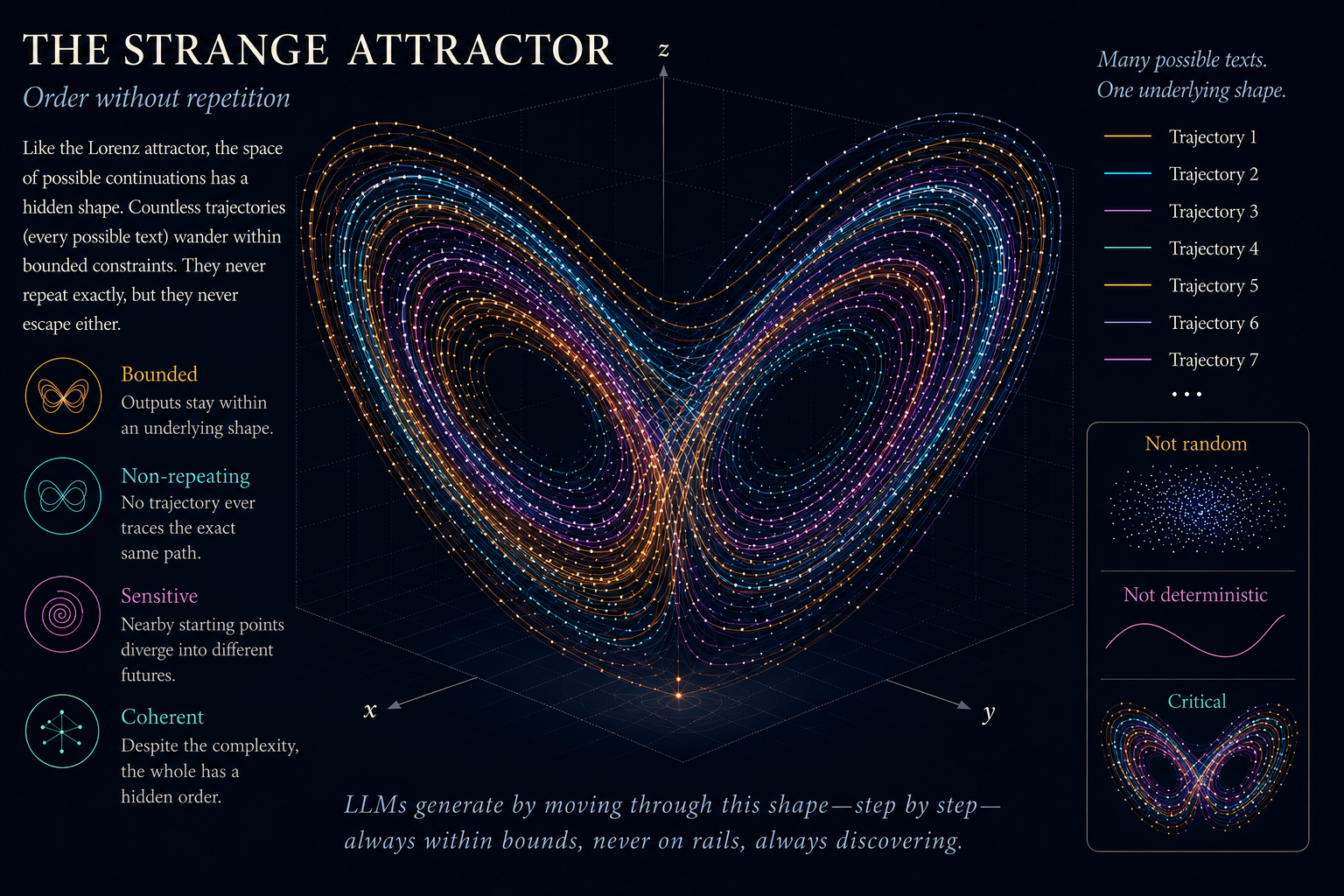
3.2 A strange attractor
During autoregressive generation, this learned structure pulls the trajectory of hidden states toward itself. Start from any reasonable prompt, and the model's activations quickly settle onto the manifold and stay there, producing coherent language rather than drifting into the vast nonsensical regions of the space. In dynamical systems, a set of states that trajectories converge toward is called an attractor. The simplest kind is a fixed point. A ball released anywhere inside a bowl always rolls to the bottom. If the learned structure were this kind of attractor, every prompt would converge toward the same output.
The behavior of LLMs during generation looks more like a strange attractor, where "strange" refers to the geometry of the attracting set (irregular, possibly fractal, with structure at many scales) as well as the sensitivity of the output to changes in the input context. Edward Lorenz first discovered these in the 1960s while modeling weather [6] as a system that never settled to a fixed point or a repeating cycle. It traces out a bounded region of its phase space (the famous butterfly pattern) without ever repeating itself. Weather has the same character. Temperatures stay within ranges, storms have recognizable structure, and yet the exact sequence never repeats. You cannot predict the specific trajectory, but the statistical properties of where the system spends its time are stable and well-defined. Climate is the statistics; weather is the trajectory.
LLM inference fits this pattern.3 The outputs are bounded (coherent language, not noise) but never repeat exactly. The model stays on the manifold, producing text with the right statistical properties, while each generation traces a unique path. Two properties of strange attractors connect to specific features of how these models behave. First, fractal geometry: the attractor has structure at every level of magnification with no characteristic scale. If the encoded statistics are near-critical, it would be natural for the geometry representing them to be as well. A smooth manifold with uniform curvature would be a surprising home for scale-free data. A fractal geometry is the natural fit.4
Second, sensitive dependence. Anyone who has used these models has observed that changing a single word in a prompt, or running the same prompt with a different random seed, can produce completely divergent text within a few sentences. Recent work measuring quasi-Lyapunov exponents across transformer layers suggests this may constitute chaos in the formal mathematical sense [9].
Other empirical work supports both of these predictions. Alabdulmohsin, Tran, and Dehghani [12] measured fractal self-similarity in language as seen through LLMs, finding that fractal parameters substantially improve prediction of downstream performance beyond perplexity alone. A follow-up study [13] found that natural language occupies a narrow range of fractal parameters, while LLM-generated text varies widely. This is consistent with a view of models converging toward the critical geometry without having fully reached it. Temperature and prompting affect these fractal parameters even when perplexity appears unchanged, suggesting that the critical regime governs more than local prediction accuracy.
3.3 Why next-token prediction learns everything
If LLMs are trained to predict just the next token, one token at a time, how do they end up learning structure at every scale? The answer lies in what the training objective actually penalizes.
Cross-entropy loss measures how surprised the model is by the token that actually comes next. Crucially, it penalizes any missed correlation, regardless of range. If a word choice five hundred tokens back makes one continuation more likely than another, and the model fails to account for that, the loss increases. There is no discount for distance. A dependency spanning the entire context window hurts the loss function just as much as a dependency between adjacent words.
For near-critical data, this means the training objective applies pressure across the full spectrum simultaneously. The model cannot minimize its loss by learning only local patterns and ignoring long-range ones, or by capturing paragraph-level structure while neglecting word-level transitions. Minimizing cross-entropy on near-critical data is, in effect, a search for the most compressed model of a near-critical distribution. The training objective and the critical geometry of language converge not by design but by the nature of the data.
3.4 The forward-looking hidden state
There is a deeper point here, and it is the central claim of this article. The training objective is formally one-step prediction: given the past, predict the next token. A skeptic might accept everything to this point and still maintain that this produces a model sensitive to long-range context in its input without conceding that there is any modeling or representation of the future beyond the immediate next token. Better memory of the past, but not anticipation of what's ahead.
This objection fails and the quote from the opening provides the intuition for why. Consider what it takes to choose the right word in the middle of a sentence. The grammatical object of a verb that hasn't been written yet is already constraining what that verb can be. A clause opened two sentences ago is creating an obligation that must eventually resolve. A topic introduced at the start of a paragraph is shaping which words are semantically coherent right now. An introductory paragraph contains the outline of all that will follow. These are forward constraints; structures that do not yet exist in the generated text, but whose eventual shape is already determining what the current token can coherently be. The next token is always embedded in a web of both backward and forward obligations.
Predicting the next token well is therefore inseparable from having already formed a representation of long-range future structure. A model that predicts reliably across the full training distribution must have learned about the probable sentences and passages not yet generated. The only way to be consistently good at the one-step objective on near-critical data is to have internalized the forward geometry of long-range correlations that the data imposes at all scales.
The Information Bottleneck (IB) framework formalizes this.5 The IB principle says that the optimal compressed representation of an input, given a prediction target, discards everything about the input irrelevant to the target while retaining all that is relevant. For a model trained to predict the next token, the formal target is just one token ahead. But for near-critical data, the information that bears on the next token includes the forward constraints established above: the unfinished clause, the unresolved obligation, the trajectory of the argument. Retaining what is relevant to the next token means retaining a representation of the future at multiple scales because the choice of this next token will constrain (and is constrained by) the final output token that could potentially be generated thousands of autoregressive cycles later. The optimal hidden state is therefore not a narrow one-step predictor but a forward-looking belief state over the space of probable continuations. Real transformers trained by stochastic gradient descent (SGD) only approximate this ideal, but the pressure toward it from the training objective is real.
The 1/f spectrum from Section 2 provides a related line of evidence. This spectrum is the Fourier transform of the autocorrelation function, and autocorrelation is symmetric by definition: R(τ) = R(−τ). A critical correlation between positions t and t + 500 has the same magnitude regardless of which direction you measure it. This suggests that the model learns a geometry encoding correlations at every scale, where those correlations carry comparable information in both temporal directions. Though language describes directional processes like causation, narrative, and temporal sequence, the statistical dependencies between tokens are symmetric. A cause predicts its effect, but an effect equally predicts its cause. What the model's geometry encodes are the correlations, not the causal arrows.
Recent work on reverse language models illustrates this. Models trained to predict the previous token rather than the next converge to comparable performance [15]. And for over half of the texts studied, reverse prediction was actually easier; particularly for higher-quality, more logically coherent text such as books and academic papers [14][15]. This is consistent with the idea that the underlying correlation structure is largely direction-agnostic. Tighter long-range correlations make the choice of direction less consequential because the structure is visible from either end.
3.5 The self-fulfilling loop
The autoregressive feedback loop is the mechanism by which this implicit future gets materialized. When the model samples a token, that token is immediately appended to the context and fed back in as input to the next forward pass. From that point until the next sampling step, everything is deterministic. The same input always produces the same hidden state, the same hidden state always produces the same logits, the same logits always produce the same distribution. The only randomness is the sampling step itself, one per token.
This creates a self-fulfilling structure. The model's internal representation of where the text is going shapes which token gets sampled. That token then feeds back in, and the next hidden state is computed deterministically from the full context including the new token. The geometry that slopes toward a coherent completion guided the sample; the sample advanced the context one step further along that slope; and the next forward pass re-derives the forward-looking representation, updated and sharpened by the new information. The future the model represents becomes, step by step, the future it produces.
Note what's happening here. The model has no persistent memory between forward passes. It re-derives the shape of the thought on every pass from the accumulated context and the geometry it learned during training. So when I say the forward structure is present from the start, I mean present in the geometry, not in any persisted internal state. The learned geometry is the memory. Each forward pass activates the relevant region of that geometry, and that region encodes the forward-looking correlations, including the ones that haven't yet materialized as tokens. The autoregressive loop then turns those implicit commitments into explicit text.
This is not planning in any deliberate sense. The model has no explicit target it is steering toward. But the learned geometry, trained to reflect the correlations and forward obligations of language, does the same work.
3.6 The localism fallacy
"Next-token prediction" is misleading as a description of what the model is doing. The phrase describes the training objective, the quantity being optimized. Yes, the generation mechanism during inference operates token by token. But the computation behind each token prediction draws on the full global structure the model has internalized, encoding correlations from the sub-word level to the scale of entire documents and beyond.
Call this the localism fallacy: observing that the mechanism is local and concluding that the computation must be local too. A weather station measures temperature at a single point, but the reading reflects the state of the entire atmosphere including pressure systems hundreds of miles away, ocean currents, and jet streams. The measurement is local. What it measures is not.
Per Bak's sandpiles illustrate this point. Grains of sand are dropped one at a time onto a pile. Each grain is a local event. You can study every grain in complete detail, characterize every micro-collision, catalog the forces at every contact point. None of that analysis will predict the distribution of avalanches. Small avalanches are common. Large ones are rare. The sizes follow a power law, and that distribution is a property of the critical state of the whole pile. If LLMs are operating near criticality, some of their most consequential properties (long-range coherence, capabilities that emerge at scale, power-law scaling) may likewise be properties of the global critical state, visible only to tools that measure the geometry as a whole rather than dissecting its parts.
4. Generation as Progressive Resolution
Imagine a telescope pointed at a distant galaxy. The image is already there before you adjust the focus. The light has arrived, and a blurry version of the galaxy is visible, recognizable even through the blur. Focusing doesn't create the galaxy; it removes uncertainty. Each adjustment collapses a little more blur and sharpens a little more detail. The object being observed was always the object. It was just being measured imprecisely.
The parallel here is closer to the mechanism of LLM inference than it might seem, and it's worth being precise about why. When an LLM processes a prompt, it produces a specific activation point in its high-dimensional phase space. That point is fully determined by the prompt and the model weights, with no randomness yet. But from that point, the weights also determine a probability distribution over the next token, which determines a probability distribution over the next activation, which determines a probability distribution over the one after that, and so on. The result is a tree of future activations, each node a real point in phase space, each edge a token choice with a real probability. That tree is implicit but fully determined by the first activation. The shape of the complete thought, as a space of coherent continuations weighted by their likelihood, is encoded in the starting point as a mathematical consequence, not a metaphor.6
This tree structure reveals something the next-token framing obscures: a form of backwards correlation running from ungenerated future tokens back into the present activation. Each node in the tree carries a weighted distribution over its branches, and that distribution is part of what defines the node's position on the manifold. Tokens that haven't been sampled yet are already shaping the current hidden state, because the geometry encoding their probability distribution is baked into the activation itself. The future is present not as a prediction but as a constraint. This is what the opening quote captures precisely: knowing the end of the sentence isn't a cognitive luxury, it's a structural requirement. The current word's position on the manifold is partly determined by the words that haven't arrived yet.
Generation is then path selection through that tree. Each sampled token collapses one level of branching, committing to one subtree and abandoning the others. The remaining tree, still fully determined by the new activation, is now narrower: fewer high-probability branches remain consistent with what has already been said. The thought is being resolved, step by step, from an implicit weighted tree into a single explicit path. This is what the telescope analogy is pointing at. The galaxy was always there; the tree was always there. Sampling tokens is focusing.
The 1/f statistics of language are consequential for how this resolution proceeds. If language has correlations at every scale simultaneously, then each token carries information about the future at multiple scales: a little about sentence-level structure, some about paragraph-level direction, and a bit about the overall thematic trajectory as well. Individual tokens may be more informative at some scales than others, but across many tokens, no single scale dominates the process. The resolution is distributed across all scales at once, because that is what a scale-free correlation structure requires.
This is why coherent generation requires operating near the critical regime. The manifold's structure couples local choices to global trajectory, so that picking the next word and advancing the larger argument tend to happen together. Drift away from that regime, by distorting temperature, or by training on too little data to capture the full structure, and the coupling weakens: local fluency and global coherence come apart.
5. Scaling Laws, Emergence, and the Critical Fixed Point
The previous sections argued that language has near-critical statistics and that LLMs learn geometry reflecting that structure. This section connects those claims to two widely discussed observations: why model performance scales as a power law with size and compute, and why qualitatively new capabilities appear at scale thresholds.
5.1 What scaling laws are actually telling us
The empirical scaling laws [10] show that loss decreases as a power law in model size, dataset size, and compute. Double the parameters and performance improves by a predictable amount. Double again and it improves by the same factor, across many orders of magnitude with no characteristic scale where it breaks down or saturates.
Power laws with no characteristic scale are consistent with criticality, and the framework offers a natural interpretation. As a model grows, it tracks correlations across progressively greater distances. A small model captures word-level and phrase-level dependencies. A larger one begins to resolve sentence-level and paragraph-level structure. Larger still and document-scale and genre-scale correlations come into range. Each increment of scale brings the model's internal representations into alignment with one more octave of the correlation structure in the training data.
Note, however, that power-law scaling can arise from simpler mechanisms. Diminishing returns on a learning curve, for instance, produce power-law-like behavior without any connection to criticality. The criticality framework does not derive the observed scaling exponents from first principles. What it offers is a reason why the relationship might be scale-free, and one that connects to the same underlying structure (near-critical correlations). That coherence is merely suggestive, not proof.
5.2 Emergence as new correlation scales come into range
Certain capabilities appear at scale thresholds rather than improving smoothly. Models below some size show near-chance performance on a task, whereas models above it perform well. Whether this reflects a true discontinuity or an artifact of measurement has been debated, but the distinction doesn't affect the broader framework. What the criticality picture predicts is that new correlation scales become accessible as models grow. In-context learning requires tracking statistical relationships across the full context window. Chain-of-thought reasoning requires maintaining coherent logical structure across many steps. As models grow, they can operate across larger codebases and work for longer stretches while maintaining coherence because the correlation scales they can track expand with size. These capabilities depend on correlations at scales that only come into range above some model size, and below that threshold the relevant dependencies simply aren't representable.
6. The Shape of the Space
Natural language has the statistical fingerprints of a system near a critical point: power-law word frequencies, power-law decay of correlations, 1/f noise across timescales. These are three measurements of one underlying structure. LLMs trained on this data, with a training objective that penalizes every missed correlation regardless of range, are driven toward internal representations that reflect that critical geometry.
Generation is a walk across that learned manifold, held to it by the attractor dynamics of autoregressive feedback, progressively resolving a belief state that encodes the shape of the complete thought from the first forward pass. Temperature governs whether generation explores the critical regime the model was trained to represent, or drifts into incoherent noise.
The training objective is absurdly simple: predict the next token. No explicit grammar rules, no semantic axioms, no built-in notion of topic or argument or narrative. Just given what came before, what comes next? Applied to a near-critical distribution, this objective recovers the full correlations across language, because it captures the scale-free geometry hidden in the training data.
This is more than a redescription of successful optimization. A generic account in which the model "learned the weights really well" is true but makes no specific predictions. The criticality framework does. It predicts that performance should scale as a power law with model size, because convergence toward a scale-free geometry is itself scale-free. It predicts a narrow temperature band for coherent generation, because the model must operate near the critical regime it was trained to represent. It predicts that capabilities should appear at size thresholds, because each threshold brings a new correlation scale into range. And it predicts that local token choices should couple to global coherence, because on a scale-free manifold no scale is independent. These are not restatements of "the model is well-optimized." They are consequences of a specific structural claim about what the optimization found.
6.1 What remains open
This framework is a synthesis, not a proof. Several of its central claims are testable but not yet tested:
- Whether the learned manifold is fractal and the attractor strange in the technical sense. The intrinsic dimensionality measurements are suggestive, but the connection to criticality remains to be established.
- Whether the scaling exponents observed in practice can be derived from the critical structure of language, rather than merely being consistent with it.
- Whether the model's internal representations capture causal structure or only statistical regularities.7
- Whether the autocorrelation symmetry argument carries the weight placed on it, or whether the direction-agnostic character of the learned geometry is better supported by the reverse modeling results alone.
These are open empirical questions, and until they are answered the framework sketched here remains a suggestive synthesis that builds on areas being actively researched.
There is also a practical dimension worth investigating. If the learned geometry is truly scale-invariant, then not all context is equal. Input that spans multiple scales, from fine-grained detail up to high-level structure, should activate richer representations than context concentrated at a single level. Getting that mix right may matter as much as getting the content right, and understanding how context composition interacts with the model's internal geometry is a productive avenue for future work.
Models don't converge on language; they converge toward it. The target is a near-critical system in the same universality class as natural language, and the gap never fully closes because the target itself is a living distribution that speakers continue to generate and reshape. Sometimes solving new problems requires adding new words and symbols to the language. Each increment of scale is a closer approach to the critical geometry. Scaling laws follow power laws because performance tracks convergence toward that geometry. Capabilities emerge at scale thresholds because each threshold marks a new correlation scale coming into focus. The ceiling, if there is one, is the geometry itself, or what our language can describe. LLMs don't just learn what we say, they learn the geometry of what can be said.
References
[1] Shannon, C. E. "Prediction and Entropy of Printed English." Bell System Technical Journal 30(1), 50–64, 1951.
[2] Dębowski, Ł. "Excess Entropy in Natural Language: Present State and Perspectives." Chaos 21(3), 037105, 2011.
[3] Ebeling, W. & Pöschel, T. "Entropy and Long-Range Correlations in Literary English." Europhysics Letters 26(4), 241–246, 1994.
[4] Bak, P. How Nature Works: The Science of Self-Organized Criticality. Copernicus (Springer), 1996.
[5] Calvo, G. et al. "Robust Scaling in Human Brain Dynamics Despite Correlated Inputs and Limited Sampling Distortions." Physical Review Letters 136, 2026.
[6] Lorenz, E. N. "Deterministic Nonperiodic Flow." Journal of the Atmospheric Sciences 20(2), 130–141, 1963.
[7] Ansuini, A. et al. "Intrinsic dimension of data representations in deep neural networks." Advances in Neural Information Processing Systems 32, 2019.
[8] Aghajanyan, A. et al. "Intrinsic Dimensionality Explains the Effectiveness of Language Model Fine-Tuning." Proceedings of the 59th Annual Meeting of the ACL, 2021.
[9] Li, X. et al. "Cognitive Activation and Chaotic Dynamics in Large Language Models: A Quasi-Lyapunov Analysis of Reasoning Mechanisms." arXiv:2503.13530, 2025.
[10] Kaplan, J. et al. "Scaling Laws for Neural Language Models." arXiv:2001.08361, 2020.
[11] Tishby, N., Pereira, F. & Bialek, W. "The Information Bottleneck Method." Proceedings of the 37th Annual Allerton Conference, 1999.
[12] Alabdulmohsin, I., Tran, V. Q. & Dehghani, M. "Fractal Patterns May Illuminate the Success of Next-Token Prediction." Advances in Neural Information Processing Systems 37 (NeurIPS), 2024.
[13] Alabdulmohsin, I. & Steiner, A. "A Tale of Two Structures: Do LLMs Capture the Fractal Complexity of Language?" Proceedings of the 42nd International Conference on Machine Learning (ICML), PMLR 267, 2025.
[14] Yin, X. et al. "LEDOM: Reverse Language Model." arXiv:2507.01335, 2025.
[15] Yu, S. et al. "Reverse Modeling in Large Language Models." Proceedings of the 2025 Annual Conference of the North American Chapter of the ACL (NAACL), 2025.
[16] Quiroga Rodríguez, E. "A Chaos-Based Conceptual Model for Understanding the Performance of LLMs." Universidad del Atlántico Medio.
[17] Hilberg, W. "Der bekannte Grenzwert der redundanzfreien Information in Texten — eine Fehlinterpretation der Shannonschen Experimente?" Frequenz 44(9–10), 243–248, 1990.
Footnotes
1 Dębowski [2] provides the key estimates here. They are sensitive to finite-size effects and corpus boundaries, so the exact exponents carry some uncertainty, but the qualitative result, power-law rather than exponential scaling, is robust.
2 The "critical brain hypothesis" that neural dynamics operate near a phase transition to optimize information processing has accumulated substantial evidence. Calvo et al. [5] recently showed that, after controlling for subsampling and autocorrelated inputs, resting-state brain activity is slightly sub-critical yet near-critical. The scaling exponents match predictions from a simple recurrent firing-rate model.
3 Quiroga Rodríguez [16] independently developed a related framework from the perspective of chaos theory, modeling prompts as initial conditions in a high-dimensional dynamical system and generation as trajectories gravitating toward "semantic attractors" in phase space.
4 There is a growing body of work measuring the intrinsic dimensionality of neural network activation spaces, though it doesn't directly test the fractal geometry prediction made here. Ansuini et al. [7] used the TWO-NN estimator to measure intrinsic dimensionality across layers, finding that it varies non-trivially with depth. Aghajanyan et al. [8] showed that pre-trained language models have surprisingly low intrinsic dimensionality, which they connected to fine-tuning effectiveness. Both find non-integer effective dimensions, which is suggestive but not the same as establishing fractal geometry in the critical-systems sense.
5 The Information Bottleneck framework [11] says that the optimal compressed representation of an input discards everything about the past that doesn't help predict the future while retaining everything that does. For a model trained to predict what comes next, this converges to P(future|past) compressed into a hidden-state vector.
6 The tree is large in absolute terms, but relative to the full activation space, the tree is vanishingly small. Relative even to the full learned manifold, which encodes all coherent paths through language, the tree rooted at a given prompt is a tiny constrained subset of only those continuations consistent with this context and its implicit forward geometry. The first activation has already done most of the work. What the tree represents is the structured residual after almost everything has been ruled out. This is also why the backwards correlation claim isn't just a reframing of next-token prediction. A model doing pure local prediction with no long-range structure would produce a tree where branches at depth 50 are essentially independent of each other. The claim here is that branches remain correlated across depth because the manifold's geometry couples them. Two paths that diverge early still share the forward obligations inherited from the root. That coupling is what makes the tree's probability distribution genuinely informative about the complete thought, rather than just a record of local transition probabilities.
7 In Pearl's causal framework, each sampled token functions as something like an intervention on the belief state: a do(token=x) that injects new information not present in the prior context, though whether sampling from the model's own distribution constitutes a true intervention in Pearl's sense is itself debatable. Whether training on near-critical data pushes the model beyond association (Pearl's Rung 1) toward intervention or counterfactual competence (Rungs 2 and 3) is an open question, and marks the boundary of what this framing can claim.